CHIP-TRACKER 9000: Building an Imperfect 4-Era Web Chiptune Synthesizer with Real Hardware Quirks
"Why clean mathematical digital audio sounds sterile, and how we engineered real hardware quirks like 18Hz AC-coupling, SID filter screaming, and NES triangle bass plucks in Web Audio."
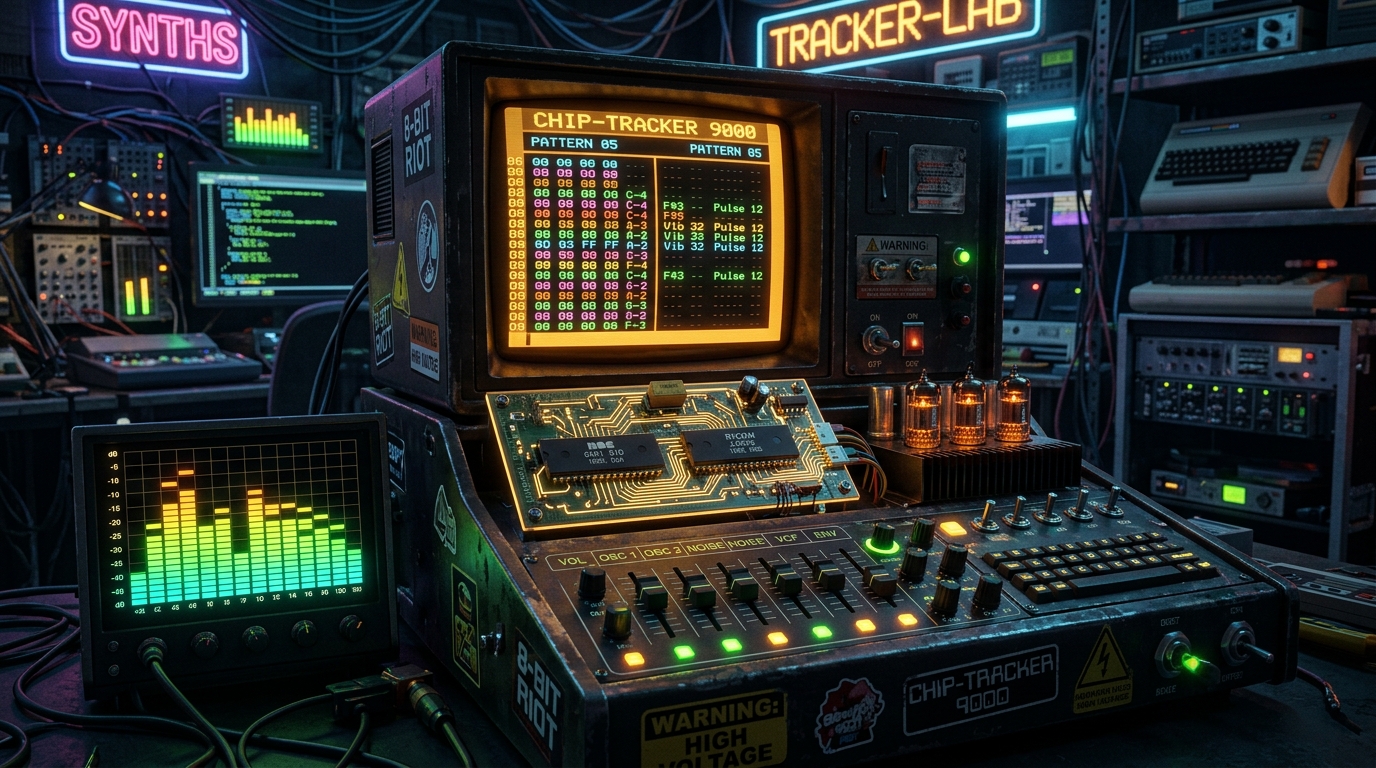
01.The Flawless Math Trap
When developers first build chiptune synths in Web Audio, they almost always create a pure OscillatorNode('square') or OscillatorNode('sawtooth'). Mathematically, it produces exact geometric waveforms. Acoustically, it sounds like sterile laser surgery.
Real 1980s sound chips were messy analog beasts. The Commodore 64's MOS 6581 had leaky capacitors and non-linear filter distortion. The NES 2A03 triangle channel lacked volume control and produced distinct downward pitch thumps when keyed. The Sinclair Spectrum beeper was literally a CPU transistor clicked in software.
To make CHIP-TRACKER 9000 feel authentic, we had to deliberately re-engineer the flaws back into the code.
02.1. The 18Hz AC-Coupling DC-Blocker Filter
When a 1-bit beeper toggles between 0 and 1, it outputs raw DC voltage offset. In real hardware, the CRT TV amplifier has an AC-coupling capacitor that filters out sub-audible DC transients. Without it, software spectrum visualizers get pinned at 0Hz, and headphone drivers suffer from DC drift.
We resolved this with an 18Hz Butterworth highpass filter before the master analyzer:
const dcBlocker = ctx.createBiquadFilter();
dcBlocker.type = 'highpass';
dcBlocker.frequency.value = 18; // Eliminates 0Hz clicks without cutting bass
dcBlocker.Q.value = 0.707;
masterGain.connect(dcBlocker);
dcBlocker.connect(analyser);03.2. The 4 Distinct Synthesis Eras
Instead of generic 8-bit beeps, CHIP-TRACKER 9000 runs 4 isolated synthesis pipelines:
- ★📼 1-Bit Beeper (1977 - 1984): 2 channels of pure binary pulse clicks. Drums are CPU-stepped pulse bursts.
- ★💾 C64 SID 6581 (1982 - 1992): 3 channels featuring non-linear resonant lowpass sweeps (Q up to 8.5), 32-sample noise polyphony, and singing pulse-width modulation.
- ★🕹️ 8-Bit Console (1983 - 1993): 5-channel NES 2A03 architecture with 25ms downward triangle pitch-plucks, delayed Capcom vibrato on leads, and 4-voice detune chorus.
- ★👾 16-Bit Arcade (1988 - 1996): 8 channels of 4-operator Yamaha YM2612 FM cross-modulation, stereo panning, and metallic gated snare hits.
04.3. Procedural Hashing & Seed Sharing
Every track in CHIP-TRACKER 9000 is procedurally synthesized from a seed string. When you hit randomize or select a preset like ⭐ VITLING (honoring David Whiting) or ROB_HUBBARD, the engine generates scale-quantized melody vectors, arpeggiator patterns, and drum grooves.
The active seed, tempo, scale, and sound engine era are encoded directly into the URL query parameters so you can share any composition with a single link.